Article 22:HexaDB Debuts at 2025 Database Conference
Recently, the main forum of the 2025 Database Development Conference (hereinafter referred to as the "Conference") was successfully held in Beijing. Expert lecturers in the database field conducted discussions focusing on hot topics in database technology, industry, and ecology, jointly exploring new paths for the high-quality development of China's database industry against the backdrop of the artificial intelligence wave and data elements. Among them, Shuyi Technology was invited to attend the conference and delivered a keynote speech titled Innovative Practices of HexaDB in Industrial Digital and Intelligent Transformation, providing in-depth insights into the technological breakthroughs and practical achievements of HexaDB in the industrial internet field.
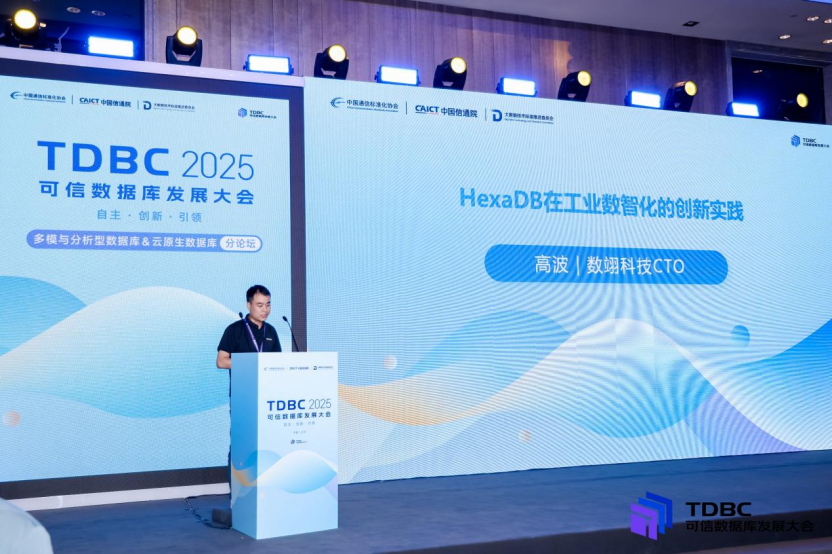 Gao Bo, CTO of Shuyi Technology, delivered a keynote speech at the forum on multi-mode and analytical database & cloud native database
I. Three Core Challenges in Industrial Digital and Intelligent Transformation
Gao Bo, CTO of Shuyi Technology, pointed out that industrial enterprises currently generally face three core demands in advancing digital and intelligent transformation:
1)Demand for cost reduction and efficiency improvement: Most process manufacturing industries have strong needs for production cost control, supply chain optimization, and equipment asset management, especially cost optimization in areas such as water, electricity, and inventory cycles.
2)Demand for quality improvement: Manufacturing enterprises urgently need to enhance product quality through digital means, including reducing product defect rates and increasing the proportion of high-quality products. This requires the realization of digital monitoring throughout the production process and process optimization.
3)Demand for safety management: Enterprises in key industries have increasingly high requirements for work safety management. In particular, enterprises with major hazard sources and flammable plant areas need industry-specific digital solutions for fire safety control.
II. HexaDB's Innovative Technology Architecture Addresses Industrial Data Challenges
To tackle these challenges, HexaDB has innovatively proposed an industrial internet solution based on a multimodal HTAP (Hybrid Transactional/Analytical Processing) database:
1)High-performance data engine:
It adopts the independently developed xStore storage engine, supporting real-time writing and analysis of tens of millions of data points per second, and achieving a data processing capacity of 200 PB per day in a cluster of 1,100 nodes.
2)Multimodal data integration:
It breaks through the limitation of the single data model of traditional databases, enabling unified management and joint analysis of time-series data, relational data, document data, etc. The multimodal data query accelerator realizes free internal data flow and integrated index acceleration.
3)High-availability architecture design:
It features the innovative 2.x replica fault self-healing technology, supports multiple operation modes, and achieves the balance of high compression ratio, low latency, and high throughput.
III. Future Outlook: In-depth Integration of Databases and AI
Digital and intelligent transformation is a systematic project that requires an ecosystem. In the future, AI will be deeply integrated with the industrial internet, and industries with a solid digital foundation will take the lead in large-scale application. Industrial large and small models will collaborate with each other to build a closed-loop system of perception-analysis-decision-evolution, realizing the digital inheritance and innovation of industrial knowledge.
HexaDB will continue to deepen technological innovation, build an industrial digital and intelligent ecosystem with industrial partners, and provide stronger data infrastructure support for enterprises' digital transformation.